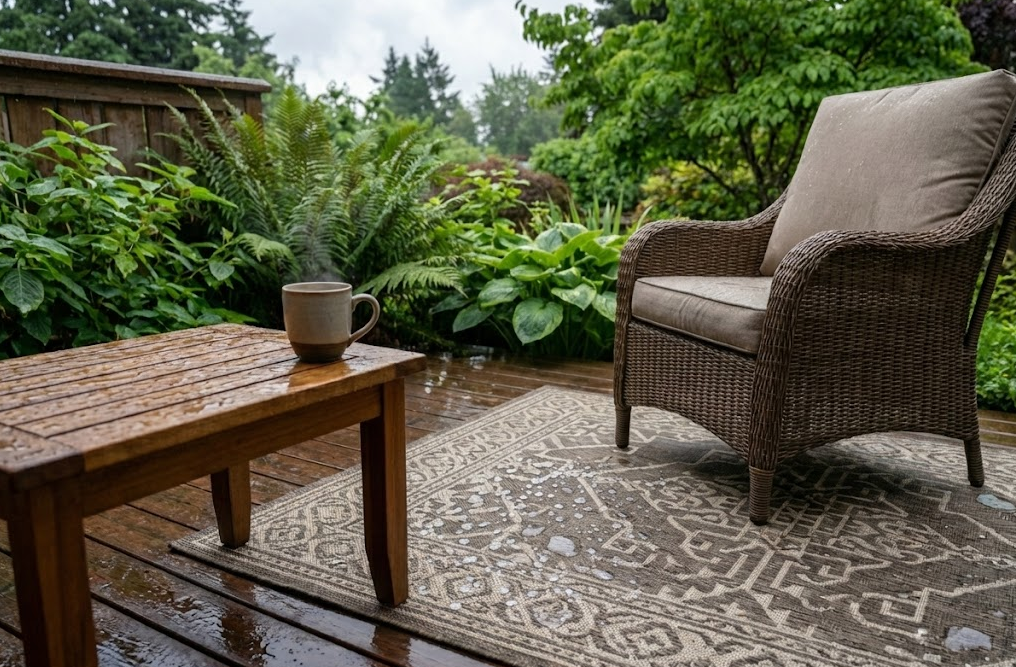
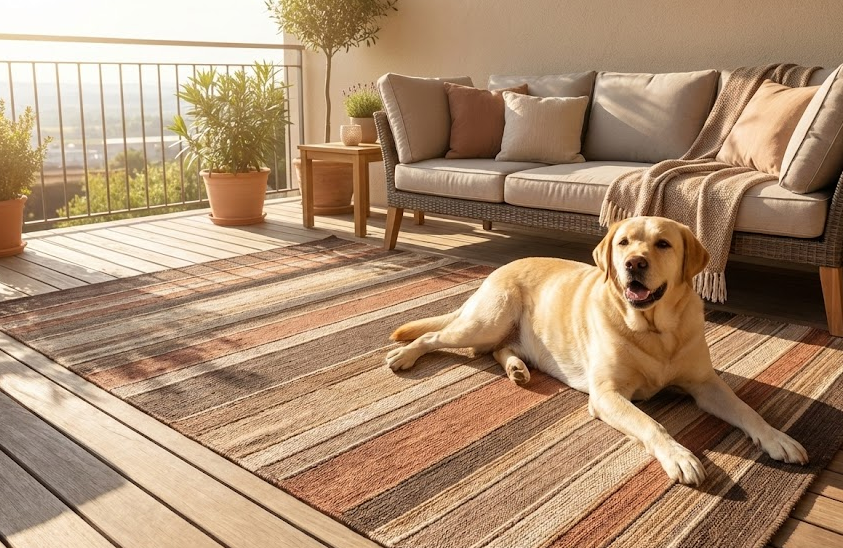
In city apartments, that small balcony often embodies all our longing for outdoor life.
Arrange a few potted green plants in a staggered manner, place a rattan chair, and lay down a carefully selected outdoor rug, and you can instantly transform a cold, hard concrete box into a warm and private space.
But honestly, as someone who has lived in an apartment for ten years, I have to pour cold water on this idea: this rug is not only the “face” of the balcony, determining its overall appearance, but also its “inner workings,” directly affecting how much of your deposit you can get back when you move out.
I. The Pain Points of Apartment Balconies: A Battle Between Aesthetics and Practicality
When choosing outdoor rugs for apartments, many people first consider whether the pattern is beautiful and whether the material is soft enough to walk on.
But behind this lies a deeper concern: Will this carpet ruin my floor?
After all, apartment balcony flooring comes in all sorts of materials, from cheap ceramic tiles to fragile wood-look tiles.
If it gets moldy from prolonged dampness or scratched by a rough backing, the “floor repair fee” when you move out can be enough to make your heart ache for a while.
Therefore, the primary task when choosing a product is not to select one that “looks good,” but rather one that “coexists peacefully.”
II. Core Selection: Seamless Material Art
When choosing outdoor rugs, the material is the first hurdle. It determines the rug’s durability and how “gentle” it is on the floor.
1. Polypropylene (PP): The “King of Durability” for Outdoors
Polypropylene outdoor rugs are the dominant material on the market and my first choice.
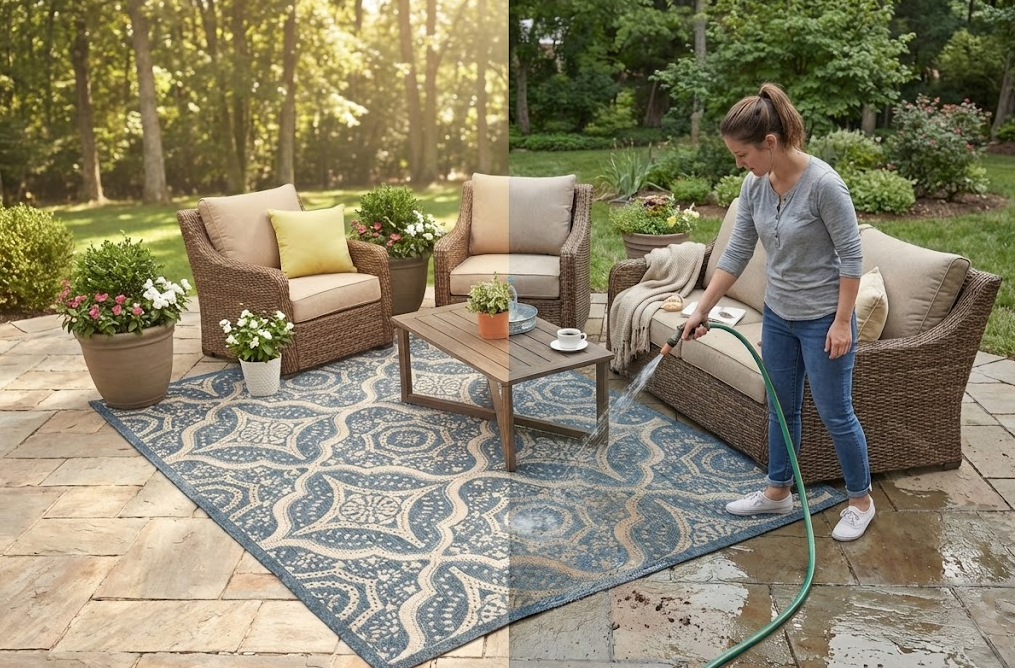
- Advantages: Extremely wear-resistant, waterproof, and mildew-proof. Cleaning is also hassle-free; just rinse it directly with a water hose.
- Flooring friendliness: The material itself is stable and will not melt and stick to the floor like rubber.
Outdoors, durability and softness are often inversely proportional.
If you’re looking for that “walking on clouds” feel when you’re barefoot, PP material might disappoint you because it is indeed quite stiff. But stiffness is what prevents it from absorbing water and getting moldy.
.(Still struggling with material choices? Check out this in-depth comparison: Outdoor Rugs Showdown: Polypropylene vs. Polyester )
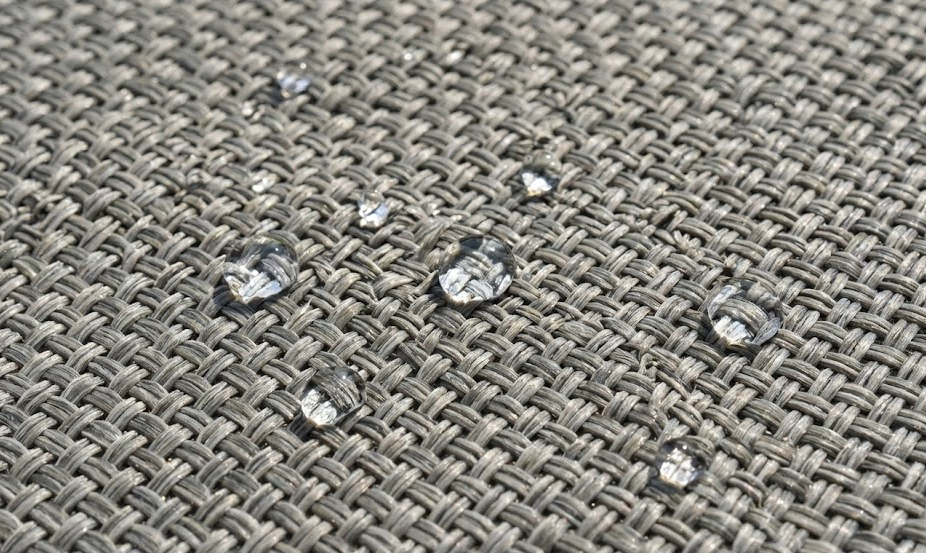
2. Recycled Plastic: Lightweight and environmentally friendly
These outdoor rugs, typically woven from recycled plastic bottles or straws, are a favorite among eco-conscious individuals.
- Advantages: Wide range of colors and extremely lightweight.
- If you’re used to taking your rugs away before a downpour (common on apartment balconies), these lightweight outdoor rugs are a lifesaver.
- They’re also usually loosely woven, making them highly breathable.
3. Natural Fiber (Jute/Sisal): Please avoid using this area on your apartment balcony.
While jute or sisal are extremely beautiful and have an Instagram-worthy filter, they are truly the epitome of “delicate” outdoors.
- Risk factors: These are absorbent sponges, which are extremely difficult to dry completely after absorbing water.
- Worse still, their rough fibers can act like sandpaper, slowly wearing down and scratching your balcony floor with repeated foot traffic.
- Therefore, please be very cautious about using this type of material to protect your deposit.
III. Backing and Drainage: The “Invisible Bodyguards” Protecting the Floor
The impact of outdoor rugs on your floor largely depends on the backing design.
- .)Rubber Backing: Offers better slip resistance. However, low-quality rubber can become sticky under high temperatures and direct sunlight, even adhering firmly to the floor and becoming impossible to remove. (This is especially problematic if your balcony has wooden flooring. See Best Outdoor Rugs for Wooden Decks for details .)
- Breathability: Ideal outdoor rugs for apartments should have good drainage and weave holes to allow air to circulate.
Don’t just listen to the seller’s claims when it comes to drainage testing. Pour a cup of water onto your outdoor rugs and see how quickly it soaks in.
I once bought a rug that was advertised as “quick-drying,” but after a heavy rain, the bottom took three days to dry, and when I lifted it up, it was covered in mold.
Later, I learned my lesson and did real-world testing: rugs that absorb water quickly and leave no stains are the real deal.
IV. Size and Layout: Rejecting a “Small-fisted” Approach
Choosing the wrong size will greatly diminish the visual appeal of outdoor rugs.
A rug that’s too small will make your balcony look like a cheap showroom.
area orThe ideal size is one that covers most of the living area, or at least allows the front legs of a chair to rest on the outdoor rugs.
- It is best to leave a 15-30 cm gap between the edge of the carpet and the edge of the balcony.
- runner rugsFor long and narrow balconies, choosing long and narrow Runner Rugs can visually stretch the space.
- For small, square balconies, a round design can break the monotony.
(Unsure about your size? Here’s a detailed guide: How to Choose the Right Outdoor Rug Sizing )
V. Style Creation: The Philosophy of Low-Saturation “Sophisticated Gray”
In outdoor environments, durability is more important than aesthetics, but smart outdoor rugs can give you both.
A golden rule to avoid: Embrace colors that “look like they haven’t been washed properly.”
Sounds strange? But it’s true. Bright white rugs look sloppy after just a few days of neglect. Earthy, low-saturation gray or beige outdoor rugs, on the other hand, blend perfectly with dust.
This “optical illusion” allows you to keep your rug looking clean without having to scrub it with a hose every week.
VI. Details and Maintenance: Nursing Tips Even Lazy People Can Do
Finally, a few small details determine its lifespan:
- Check the overlock stitching: This is the most important thing for me. High-quality outdoor rugs will have tight, multi-threaded overlock stitching. If the overlock stitching is sparse, the edges will fall apart before the summer is over.
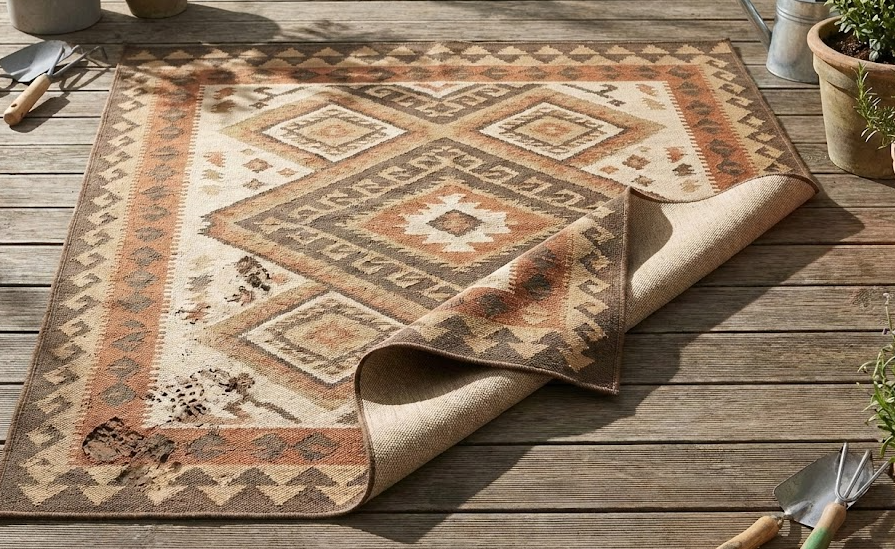
- Regularly “flip over”: This is a key habit for protecting your floors. Every one or two months, be sure to flip outdoor rugs over and let them air out, allowing the floor underneath to breathe. This is more effective than any cleaning agent.
Conclusion: Make your balcony beautiful, safe, and worry-free.
Choosing the right outdoor rug for apartments is an art of balance. It needs to satisfy your aesthetic preferences while also protecting your floors.
Selecting a rug that is durable and floor-friendly allows you to truly enjoy the slower pace of city life with peace of mind.
Want to transform your small balcony into a lounge? Check out my curated collection of outdoor rugs specifically designed for apartment balconies—style intact, no damage to your floors: Best Outdoor Rugs for Small Balconies Collection
Frequently Asked Questions About Apartment Balcony Rugs
Will outdoor rugs damage my apartment balcony floor?
What is the best material for apartment outdoor rugs?
Can I use jute or sisal rugs on my balcony?
How do I choose the right size rug for a small balcony?

About Derek Cole
Derek Cole is the Lead Editor and Material Researcher at BuyOutdoorRugs. Based in the rainy Pacific Northwest, Derek treats outdoor styling as a discipline of durability. He manages the site’s rigorous vetting process to separate the durable from the disposable.
My Outdoor Living Journey
I’ll never forget my first real attempt at styling a patio. I bought a stunning jute rug, treating my deck like an indoor living room. And boy, did nature humble me.
One week of heavy rain later, that "perfect" rug had turned into a 50-pound, waterlogged sponge. It smelled like a swamp and trapped moisture against my wood decking.
I learned that day that you can’t just copy-paste indoor rules to the outside. I started digging deeper—moving away from "looks" to understanding solution-dyed fibers and weave density.
What I Do Here
A big part of my role at BuyOutdoorRugs is cutting through the marketing fluff. I analyze "boring" specs like weave patterns so you don’t have to guess.
It’s amazing how two rugs can look identical in a photo, but one will disintegrate in the sun while the other lasts for years.
See you on the patio,
- Derek