2026 Outdoor Rugs Size Ultimate Guide: Expert Buying Strategies and a List of Things to Avoid
To be honest, when creating the ideal outdoor space, most of us usually spend our budget on those eye-catching big items—expensive teak sofas, string lights that create a great atmosphere, or green plants that are actually not very easy to care for.
: outdoor rugs.Then, when everything is in place, we often overlook a seemingly insignificant but crucial element that can determine whether the entire space feels “high-end” or “cheap” : Outdoor Rugs.
Many people might think, “Isn’t this just a mat? Just buy any size that looks good and lay it on the floor; isn’t that enough?”
As a pragmatist who has spent years tinkering in my own backyard and paid a lot of “tuition fees” for it, I have to pour cold water on you: choosing the wrong size outdoor rugs can have more troublesome consequences than you think.
At best, it will make your terrace look like a cramped, cheap showroom (I understand the pain); at worst, it will make you get stuck on the edge every time you pull out a chair or make you want to cry when you face a piece of moldy fabric while cleaning.
Size is not just about matching numbers. It’s about visual balance and the smoothness of your movement in the space and even directly affects the frequency of future maintenance.
Today, I’m sharing with you a “geek-level” size decision-making system that I’ve developed over the years. From space type and furniture layout to the hard-earned lessons I’ve learned from real money, this system ensures that every rug you choose will become the “skeleton” of your outdoor life, not a burden.
I. The Philosophy of Outdoor Space Types and Sizes: In-depth Considerations from Function to Aesthetics
Different outdoor spaces have completely different “tempers” when it comes to the size of outdoor rugs. You can’t apply the same logic to all scenarios.
1. Terrace and Courtyard: Creating a balance between “enclosure” and “flow.”
Terraces are often the heart of our outdoor living space. Here, rugs serve more than just decoration; they define the area.
- Small Balconies (2’x3′ / 3’x5′): A Touch of Elegance, Not a Complete Coverage. For compact balconies where space is at a premium, don’t consider covering the entire floor. In this case, choosing small outdoor rugs is a wise choice. They’re typically placed under a single armchair or used as a visual base for a small coffee table. Their purpose is to add a touch of color and texture while maintaining the “lightness” of the space. (If you’re decorating a small balcony, this feature might be more suitable for you: Outdoor Rug Ideas for Small Balconies.)
- Medium-sized patio (5’x7′ / 6’x9′): Supports main furniture and keeps edges “breathable.” This is the most common size range and also the easiest to go wrong with. Your main sofa, armchair, and coffee table should be able to rest partially or entirely on the outdoor rugs. Key point: Leave at least 15-30 cm (6-12 inches) of space between the edge of the rug and the edge of the patio. This isn’t just for aesthetics; it’s to give the patio a “breathing” feel. Without this space, the rug will look like a cheap plastic sheet covering the floor.
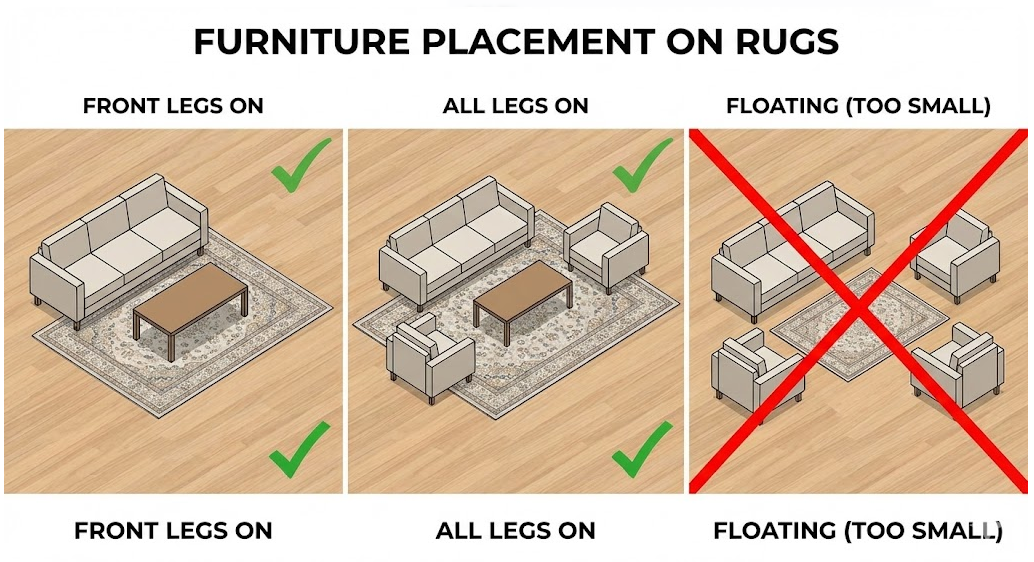
- Large patios (8’x10’/9’x12” and above): Fully enclosed, luxurious, oversized outdoor rugs are simply divine on large patios. I recommend the “fully enclosed” strategy—let all the front legs of the furniture rest on the rug, or even all of them. This sizing strategy creates an excellent sense of spaciousness, making your outdoor area look like a living room without walls.
2. Pergola: Frames the visual focal point.
A gazebo is a structural framework, and a carpet can instantly transform it from a cold “framework” into a cozy “room.”
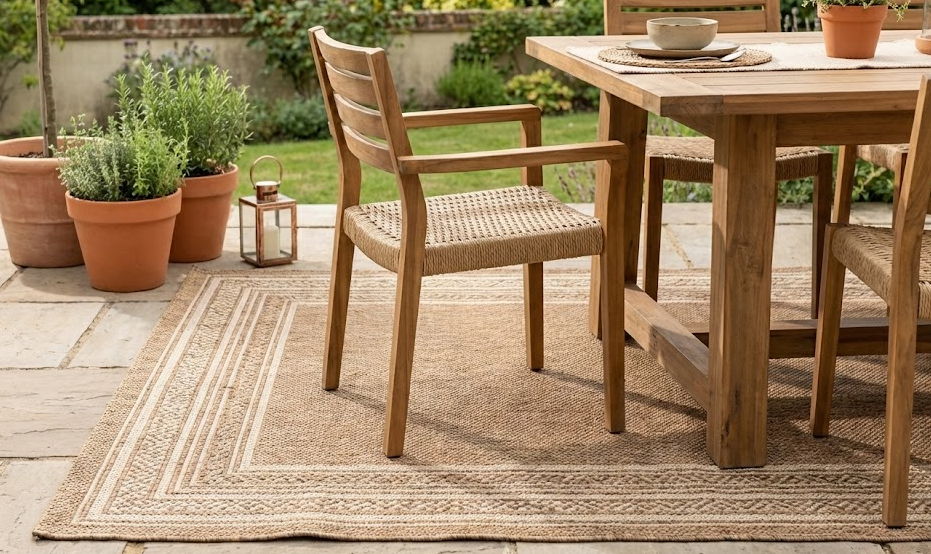
scratches butThe key principle here is that when the chair is pulled out from the dining table for someone to sit on, the back legs of the chair should still rest firmly on the outdoor rug. This is not only to protect the floor from scratches, but also to give users peace of mind—nobody wants the chair legs to suddenly “fall” off the rug when they sit down.
3. Deck and Extended Space: The Art of Transitioning Between Indoor and Outdoor Spaces
.)The outdoor rugs here need to serve as a “transition.” (Special reminder: Be extra careful with the material when choosing rugs for wooden decks to avoid rot. See Best Outdoor Rugs for Wooden Decks for details .)
II. Furniture Layout and Traffic Flow: How Outdoor Rugs Can Support Your Outdoor Life
Once the space type is determined, the next step is to decide how to arrange the furniture.
1. Relaxation Area: The “Golden Ratio” of Sofas and Outdoor Chairs
The relaxation area is for lounging around, and the carpet here is there to enhance that lazy comfort.
- and it’sThe “Front Legs On” principle: This is the most practical and economical, and my top recommendation. Make sure the front legs of all major furniture pieces (sofa, armchair) rest on outdoor rugs. This makes the furniture appear “attached,” avoiding a floating look, and saves you the budget for an oversized rug. It visually “binds” all the furniture together.
- The “All Legs On” strategy: If your budget allows, buy a large enough rug to cover your sofa, coffee table, side tables, and even floor lamps. This creates a top-notch “outdoor living room” immersive experience.
2. Dining area: The key is to pull out chairs without them getting stuck on the edges.
,In the dining area, there is only one core principle for choosing the size of outdoor rugs , and you will regret it if you violate this principle: make sure that the back legs of all chairs are still on the carpet when they are pulled out and seated.
The golden ratio: The length and width of the dining table plus at least 60 centimeters (24 inches) of extra space on each side. This “60 centimeters” is a truth learned from countless awkward experiences. It ensures that chairs have enough room to slide out without getting stuck on outdoor rugs or scraping the floor.
Dining Table Size Quick Reference Chart
|
Dining table dimensions (length x width) |
Recommended rug size (length x width) |
Applicable number of people |
|
75x75cm (30″x30″) |
150x150cm (5’x5′) |
2-4 people |
|
120x75cm (48″x30″) |
240x180cm (8’x6′) |
4 people |
|
180x90cm (72″x36″) |
300x240cm (10’x8′) |
6-8 people |
|
240x100cm (96″x40″) |
360x300cm (12’x10′) |
8-10 people |
III. Tips and Experiences for Size Selection
As a “geek” who has learned from my mistakes in the outdoor rugs field, the following tips are heartfelt.
- .)Tip 1: Don’t be fooled by the “feel.” Outdoors, durability and softness are often inversely proportional. Outdoor environments are unpredictable and exposed to wind and sun; therefore, abrasion resistance, sun resistance, and ease of cleaning are the key indicators. Polypropylene, which feels slightly plasticky, may not feel as luxurious, but its weather resistance will definitely save you a lot of trouble. (For a detailed comparison of the materials, please refer to Polypropylene vs. Polyester Showdown .)
- Tip 2: Choosing a “gray that looks like it hasn’t been washed properly” is actually the most sophisticated option. High-saturation, brightly colored rugs may look beautiful when you first buy them, but outdoors, they quickly become “assimilated” by dust and fallen leaves, turning into a dirty rag. Opt for low-saturation grays, beiges, earth tones, or mixed-color outdoor rugs with subtle textures. These blend in perfectly with dust, saving you the trouble of washing them with a hose every week.
- .Tip 3: Don’t just rely on advertisements for drainage tests. Pour a cup of water (or even some coffee) onto it after you buy it and see how quickly it absorbs. If the water droplets float on the surface or run off quickly, congratulations, you’ve made the right choice. If the water quickly seeps in and leaves a mark, then its “waterproof” claim is questionable. (Worried about mold on rainy days? Check out this article: The Perfect Outdoor Rugs for Rainy Days )
- Tip 4: The Truth About Size— Most people buy the wrong size because they’re worried about the cost. This is absolutely the most fatal mistake. An overly small outdoor rug will make your patio look like a cheap, makeshift stall. Spending a little more for a larger size is an investment whose visual value far outweighs the price difference.
IV. Precisely Measure Your Outdoor Space: The Geek’s Toolbox
Don’t just rely on your feelings; you need some hardcore methods.
- More than just measuring tape: It is always recommended to leave a 15-30 cm gap between the edge of outdoor rugs and the wall or railing.
- “The Sheet Simulation Method”: This is my favorite trick. Lay an old sheet or newspaper on the floor, fold it to the size of the rug you want to buy, and then place the furniture on it. Take a few steps, pull out a chair, and get a feel for it. This physical simulation is a million times more accurate than just imagining it in your head.
Conclusion: The perfect size enables your hassle-free outdoor lifestyle.
Ultimately, choosing the right size for outdoor rugs is a combination of rational data and a sensible lifestyle. It requires you to measure precisely and anticipate movement patterns like a tech geek and also to consider aesthetics and comfort like a connoisseur of life.
Hopefully, this guide will save you from making the same mistakes. When you sit on your beautifully decorated terrace, with a perfectly sized, durable rug under your feet, you’ll realize that all the planning and effort you put in was worthwhile.
Ready to upgrade your outdoor space? Take measurements and choose a rug that’s truly right for you: Shop Outdoor Rugs by Size (2×3 to 12×15)
Frequently Asked Questions About Outdoor Rug Sizes
How do I choose the right outdoor rug size for a dining table?
What is the “Front Legs On” rule for patio rugs?
Should I cover my entire patio with an outdoor rug?
What size rug is best for a small balcony?

About Derek Cole
Derek Cole is the Lead Editor and Material Researcher at BuyOutdoorRugs. Based in the rainy Pacific Northwest, Derek treats outdoor styling as a discipline of durability. He manages the site’s rigorous vetting process to separate the durable from the disposable.
My Outdoor Living Journey
I’ll never forget my first real attempt at styling a patio. I bought a stunning jute rug, treating my deck like an indoor living room. And boy, did nature humble me.
One week of heavy rain later, that "perfect" rug had turned into a 50-pound, waterlogged sponge. It smelled like a swamp and trapped moisture against my wood decking.
I learned that day that you can’t just copy-paste indoor rules to the outside. I started digging deeper—moving away from "looks" to understanding solution-dyed fibers and weave density.
What I Do Here
A big part of my role at BuyOutdoorRugs is cutting through the marketing fluff. I analyze "boring" specs like weave patterns so you don’t have to guess.
It’s amazing how two rugs can look identical in a photo, but one will disintegrate in the sun while the other lasts for years.
See you on the patio,
- Derek